Enterprise | AI-Assisted Development | B2B SaaS
AiWiz: AI Base Code Migration
Transforming enterprise code migration from batch tool to trust verification platform
TL;DR
Enterprise code migration was blocked by 40+ hour review cycles and missing audit trails. AiWiz reframes migration around architectural decisions instead of file diffs—surfacing what needs human judgment and auto-generating compliance documentation.
The Problem
40+ hour code review cycles blocking deployments. Engineers can't approve what they don't understand. No audit trail for compliance teams.
The Solution
Decision-first dashboard surfaces critical blockers. Inline AI reasoning explains every architectural choice. Auto-generated compliance documentation.
The Impact
60% reduction in review time (40hrs → 2hrs). 3-day decision cycles (down from 14 days). Zero failed SOC2 audits post-launch.
Review time reduction
The Challenge
Platform engineers migrating legacy systems lacked visibility into how AI made architectural decisions. Without traceable reasoning or an audit trail, they couldn't confidently approve changes or defend them to compliance teams.
Migrations didn't stall because AI converted code incorrectly.
They stalled because approval didn't scale.
The bottleneck wasn't conversion speed — it was approval confidence.
The Constraint
Legacy patterns like CICS transactions and cursor-based data access don't have 1:1 modern equivalents.
Every migration is architectural translation, not syntax conversion — and architectural decisions require human accountability.
From Conversion Tool → Command Center
AiWiz was originally positioned as a migration conversion tool—batch-process files, output modern code. The shift to "command center" reframed the product around orchestration instead of conversion. Engineers needed a decision-first dashboard that surfaced architectural blockers and AI reasoning, not a file-by-file diff viewer. This repositioning moved AiWiz up the stack from dev utility to governance layer.
AI converts code fast, but engineers can't approve what they don't understand. The bottleneck isn't accuracy—it's trust.
Five-Steps System
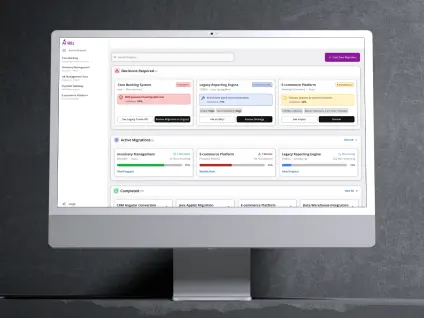
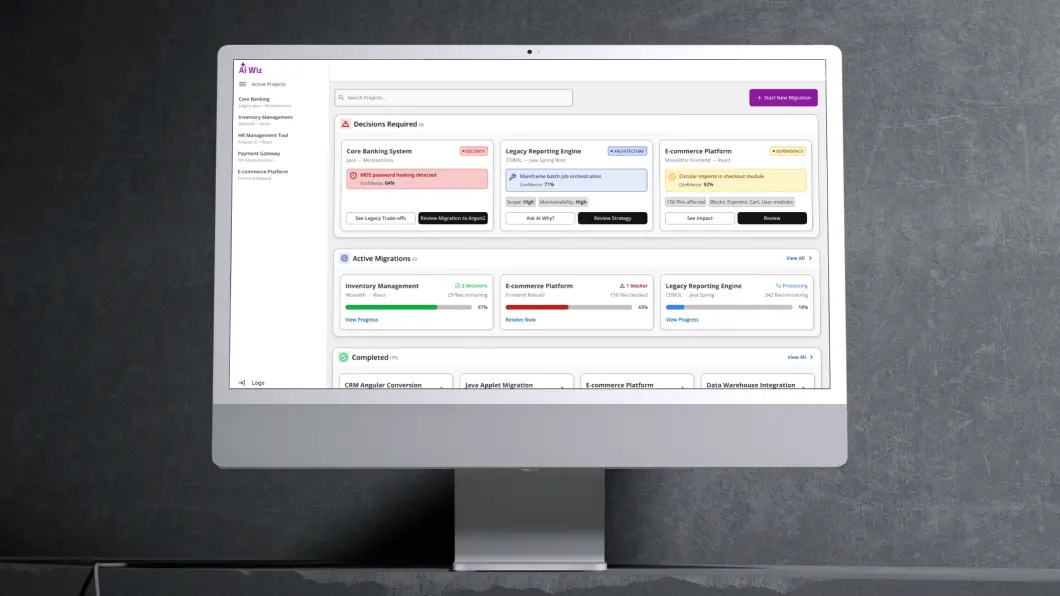
Mission Control Dashboard
Decision-first prioritization, risk-based urgency
- Decision-first dashboard
- Risk-based urgency indicators
- Confidence scoring
Risk indicators prevent critical decisions from being buried in noise
Project Deep Dive
Decision timeline + execution log + option cards
- Technical complexity indicators
- Rollback strategy visibility
- Progressive disclosure
Replaced sprint metrics with engineering-relevant dimensions: Technical Complexity, Breaking Change, Rollback Strategy
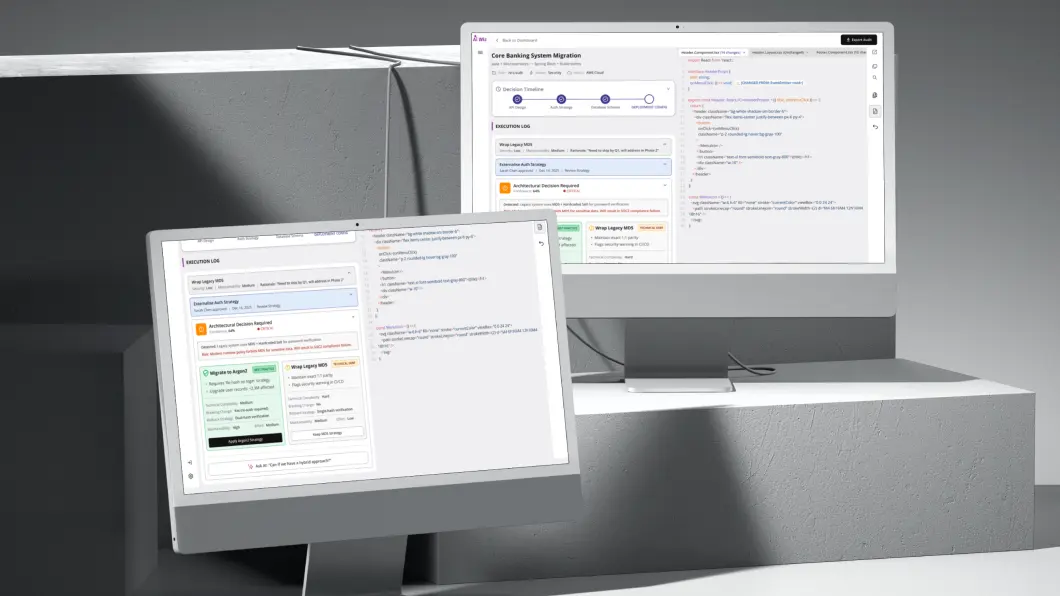
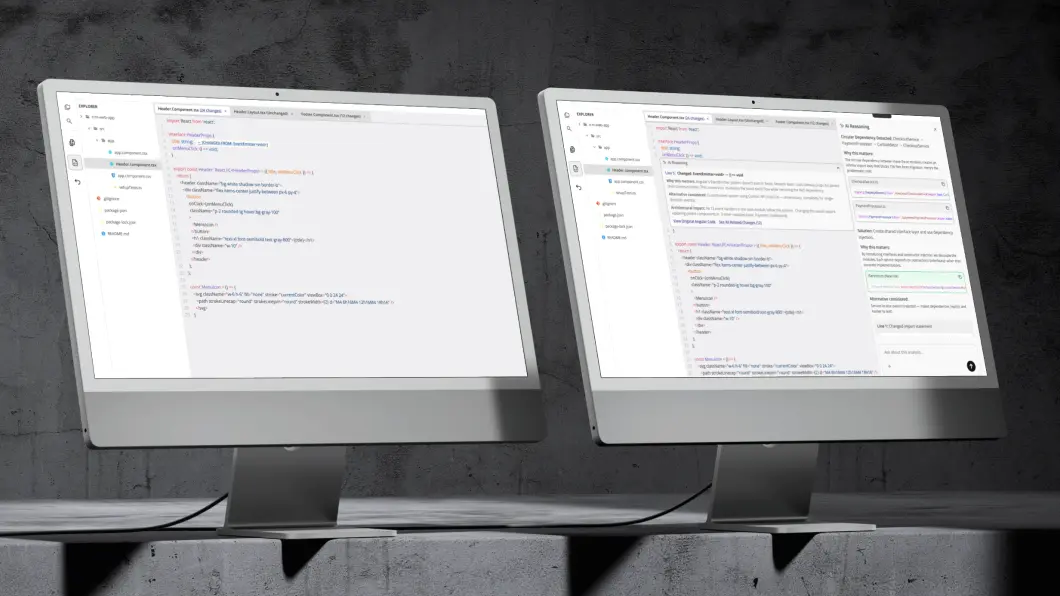
Architectural Decision Card
AI reasoning transparency — progression from collapsed → summary → full expansion
- Severity & confidence display
- Side-by-side strategy comparison
- Alternatives considered & rejected
Enterprise compliance teams need to see why AI made each choice and what alternatives were rejected
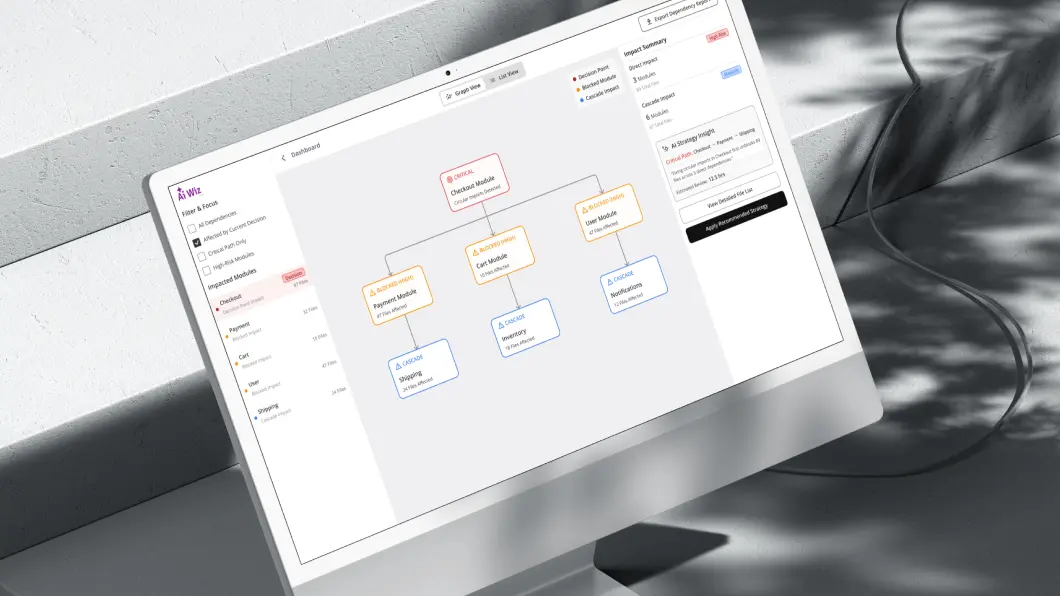
Dependency Graph
Dependency visualization for strategic sequencing
- Keystone module detection
- Critical path insight
- Direct vs cascade impact
Shows 'fix Checkout to unblock 89 files'—changes decision from tactical to strategic
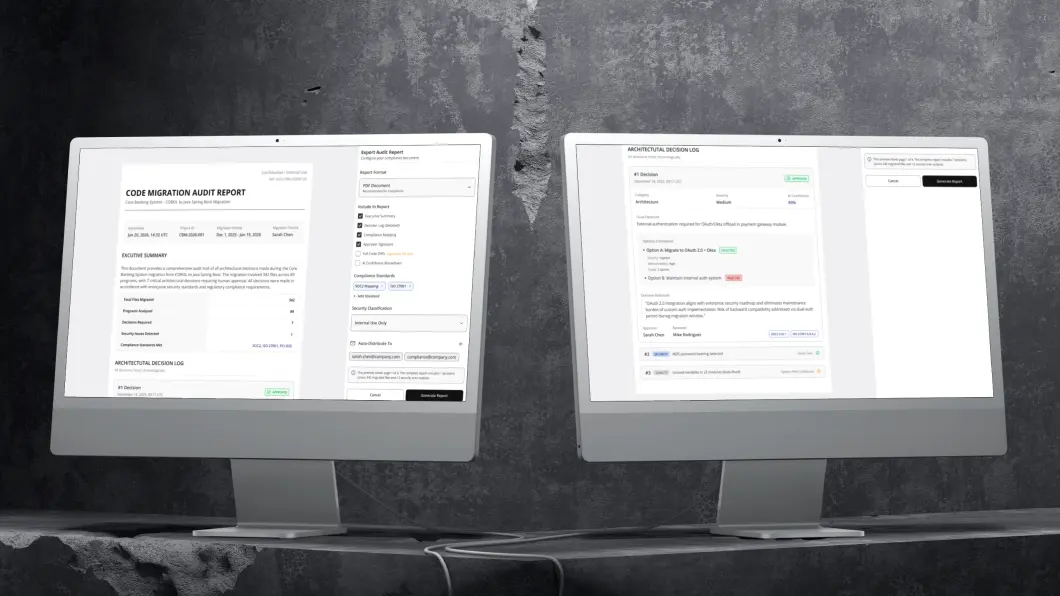
Audit Report Export
Auto-generated audit trail
- Decision log export
- Compliance mapping
- Approval records
Eliminates 3 weeks of manual documentation that used to happen after migration
The Turning Point
AiWiz started as a straightforward code conversion tool—input COBOL, output Java. Fast conversion, high accuracy. But when we watched platform engineers use it, they weren't stuck on conversion quality. They were stuck on: "How do I explain to my security team WHY the AI made this architectural choice?"
That's when we realized: the AI reasoning we built for internal debugging wasn't just useful for developers—it was the compliance documentation that regulated industries legally required. We just had to format it as an exportable audit trail.
AiWiz stopped being a code converter and became a trust verification platform.
— Engineering team retrospective, Q3 2024
Design Tensions
Speed vs. Trust
File View vs. Decision View
AI Black Box vs. Transparency
Feature Breadth vs. Depth
What Changed
From review bottleneck to strategic decision-making
| BEFORE | AFTER |
|---|---|
| 40+ hours Manual file review | 2 hours Strategic decisions |
| 14 days Decision cycle time | 3 days Decision cycle |
| 8 weeks "Figure out what this code does" phase | 3 days With dependency graph + AI reasoning |
| Manual docs — 3 weeks post-migration for compliance | Auto-generated real-time audit trail |
For a telecom provider's 342-file COBOL billing system modernization, AiWiz reduced the architectural review phase from 8 weeks to 3 days. Their platform engineering team went from "we don't know if this is safe to deploy" to "we have documented proof of every decision for our compliance audit."